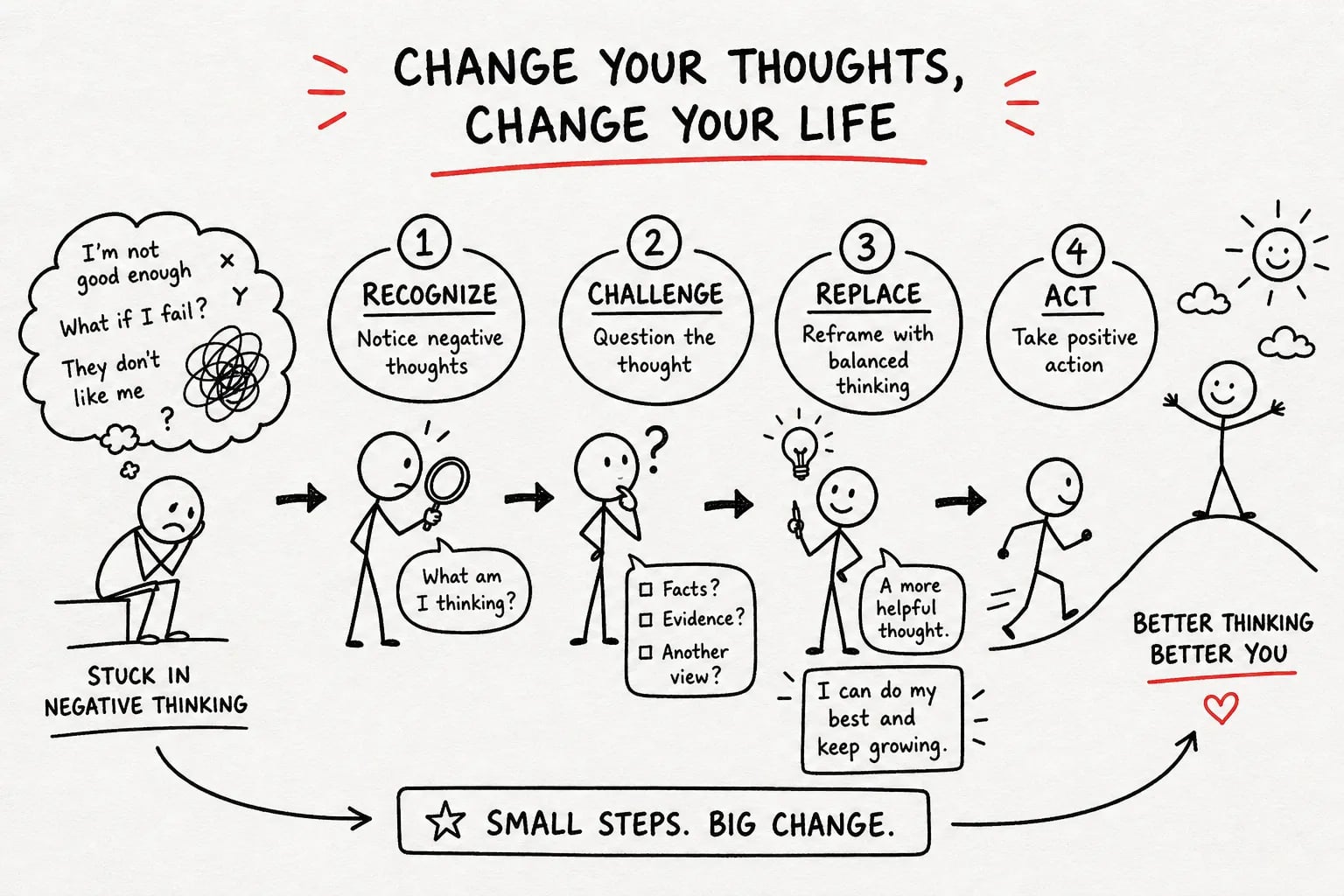
The step-by-step cognitive behavioral therapy process for a negative mindset moves from catching an automatic thought to naming the distortion driving it, examining the evidence, writing a balanced alternative, and testing that alternative through a small behavioral experiment. That repeatable cycle is what cognitive restructuring actually looks like in practice. It works because it targets the place where everything starts: how the mind interprets events, not the events themselves.
Cognitive restructuring, the core of CBT for a negative mindset, works primarily by changing how your mind interprets situations. It also includes behavioral components such as behavioral activation and exposure that change behavior and circumstances to improve mood. The goal isn’t forced optimism; it’s accuracy: trading a thought that feels true but can’t withstand scrutiny for one that reflects reality more honestly. And if you believe that your negative thinking is simply who you are, that belief itself deserves a closer look. The steps below are structured so you can start applying them today.
Key takeaways
- The core sequence: Step-by-step CBT for a negative mindset follows a repeatable loop: catch the thought, name the distortion, check the evidence, write a balanced alternative, and test it with a small action.
- Thought records are foundational: Writing thoughts down promptly, before analysis begins, is the starting point for every other step in the process.
- Naming creates distance: Labeling a thought as “catastrophizing” or “mind reading” separates you from it; the thought becomes something your mind is doing, not a verdict about reality.
- Behavioral experiments confirm new beliefs: Evidence gathered through real action often accelerates belief change compared with reasoning alone, particularly in some study contexts, though results can vary.
- Realistic timeline: Noticeable changes typically begin within 2 to 4 weeks of consistent practice; measurable improvement often appears around 4 to 8 weeks.
- Know when to get help: After 6 to 8 weeks with no measurable reduction in distress, a licensed therapist is the right next step.
What is the step-by-step CBT cycle keeping your negative mindset in place?
A triggering situation produces an automatic thought, often in a fraction of a second. That thought produces an emotion, the emotion drives a behavior, and the behavior creates new situations that feed the cycle. Most people notice only the emotion or the behavior and never the thought that generated both.
The cycle becomes self-reinforcing because the brain filters for evidence that confirms the existing belief and quietly discounts evidence that contradicts it. Avoidance behaviors lock the cycle further: when you skip a social event or stay quiet in a meeting, you never encounter the disconfirming experience that could weaken the belief. CBT for a negative mindset interrupts this cycle at the thought level, which is where the whole chain begins.
Consider a simple example. A manager walks past without saying hello. That neutral event can instantly produce the automatic thought “She’s annoyed with me,” followed by anxiety, followed by staying off a project call to avoid tension. The behavior then prevents any evidence to the contrary from entering the picture. That is the loop this step-by-step cognitive behavioral therapy process is designed to break.
How do you catch and record automatic negative thoughts?
The tool is simple: a notes app, a pocket notebook, or a printed template all work. What matters is writing thoughts down promptly, before they dissolve. A basic thought record captures four things: the situation in observable facts only, the automatic thought in the exact words it appeared, the emotion and its intensity on a 0 to 100 scale, and your belief in the thought as a percentage.
The “exact words” point matters more than it sounds. “I always fail” is a different thought than “this presentation might go badly,” and that difference changes how you challenge it. In the moment, your only job is to record; analysis can wait an hour, until emotion is less intense. Aim to complete a thought record three to five times per week rather than waiting for a major emotional event to justify the effort.
Which cognitive distortions are fueling your negative thinking?
Cognitive distortions are habitual patterns the brain defaults to under stress. They are learned shortcuts, not character flaws. The most common ones in clinical CBT work for depression and generalized negative thinking appear in the table below, each with a real-life example and a balanced reframe.
| Distortion | Real-life example | Balanced reframe |
|---|---|---|
| All-or-nothing thinking | “I missed one workout, so I’m completely undisciplined.” | “I missed one workout. Progress doesn’t require perfection; I can return tomorrow.” |
| Overgeneralizing | “I was rejected for this job, so I’ll never get hired.” | “One result doesn’t predict every future opportunity.” |
| Catastrophizing | “If I make this mistake, my career is over.” | “The mistake could have consequences, but it’s unlikely to determine my entire career.” |
| Mind reading | “My friend hasn’t replied; she must be angry with me.” | “I don’t know why she hasn’t replied. She could be busy or dealing with something unrelated.” |
| Fortune-telling | “I know I’ll fail the interview.” | “I can’t predict the result. I can prepare and consider the most likely possibilities.” |
| Emotional reasoning | “I feel like a fraud, so I must be incompetent.” | “Feeling insecure is real, but it is not proof of incompetence. What does the objective evidence show?” |
| Labeling | “I’m an idiot.” | “I made an avoidable mistake. Describing the behavior is more accurate than defining my whole identity.” |
| “Should” statements | “I should already be over this.” | “Recovery takes different amounts of time. What would a realistic and supportive expectation look like?” |
| Mental filter | “My presentation was a disaster because I stumbled once.” | “I stumbled once, but the rest of the presentation may still have landed well.” |
| Magnification/minimization | “My small error is huge; my successes don’t count.” | “I can acknowledge the error in proportion to its actual impact and give equal weight to what went well.” |
Many people repeatedly rely on a small subset of distortions rather than the full list. Identifying which patterns show up repeatedly in your own thought records is more useful than memorizing every category. Once you name the distortion, something shifts: the thought becomes something your mind is doing, not a truth about reality, and that distance is what makes the next step possible.
How do you challenge a distorted thought using CBT evidence-checking?
Start with two columns: evidence that appears to support the automatic thought, then evidence that contradicts it. Only verifiable facts, past experiences, and observable behaviors count. Feelings and assumptions don’t qualify as evidence for this exercise, no matter how convincing they feel.
Four questions sharpen the process. Ask yourself: “Am I confusing a feeling with a fact?” “What would I say to a close friend in the same situation?” “What is the most likely outcome, not just the worst one?” “What does this thought leave out?” After working through both columns, write a balanced alternative thought. It doesn’t need to be cheerful; it needs to account for all the evidence honestly.
Here’s what this looks like with a real scenario. Someone who sent a work email with a spelling mistake rated their belief in the thought “They will think I’m incompetent and this could damage my job” at 80 percent, with embarrassment at 75 out of 100. After completing the evidence columns and writing the balanced thought, “This was an embarrassing mistake and I can correct it; one typo does not define my ability or determine what my client thinks of me”, belief in the original thought dropped to 35 percent and embarrassment dropped to 40. These numbers are illustrative rather than a standardized benchmark, but meaningful reductions in both scores are the practical goal of this step, even when some negative emotion remains.
How to use step-by-step cognitive behavioral therapy for a negative mindset: behavioral experiments that lock in new beliefs
A behavioral experiment has five parts: state the belief, make a specific prediction, define what observable evidence would look like, run a small action, and record what actually happened. The goal is learning, not performing or proving yourself.
Several starting experiments are particularly useful. You might drop one safety behavior, for example, stopping the habit of over-apologizing in meetings and observing what actually happens. Another option is an imperfection test: send a “good enough” email rather than editing it five times. Or try an attention-shift experiment by focusing on the other person in a conversation rather than monitoring your own performance. Each test produces real-world data that may challenge the distorted thought, especially when the results are reviewed honestly rather than explained away.
A practical 14-day structure: Days 1 to 2, choose one belief and complete one 10-minute activation task. Days 3 to 5, repeat the activation and run two mild experiments. Days 6 to 7, review your predictions against what actually occurred. Days 8 to 12, repeat the most informative experiment three or four times while gradually reducing avoidance. Days 13 to 14, re-rate the belief, summarize the contrary evidence gathered, and choose one maintenance action for the following week. Most people begin noticing shifts within 2 to 4 weeks of consistent practice; more measurable improvement tends to emerge around 4 to 8 weeks.
When does a negative mindset need more than self-guided CBT?
Self-directed practice has real value, but certain patterns signal it has reached its ceiling. After 6 to 8 weeks of consistent work, if there is no measurable reduction in distress or thought frequency, that is a reliable indicator. The same applies when negative thinking connects to trauma, long-standing depression, anxiety disorders, or a significant life disruption such as divorce, grief, or job loss. If thought records are increasing distress rather than reducing it, or if thoughts involving hopelessness, self-harm, or feeling like a burden to others are appearing in the record, professional support is the appropriate next step.
Clinically, guided CBT produces higher response rates and better retention than self-directed work, with particular advantages at follow-up, though direct trial results vary across populations. The advantage isn’t always speed; it’s consistency and the ability to correct course when the work stalls. A clinician identifies the distortions you can’t see from inside the pattern, sequences the behavioral experiments appropriately, and adjusts when standard techniques aren’t landing.
The Owen Clinic offers Cognitive Behavioral Therapy (CBT). The Owen Clinic blends empirically grounded methods such as CBT with a Biblical worldview for clients who want their faith honored alongside clinical rigor. Reaching out for an initial consultation is itself a small behavioral experiment in asking for what you need.
Building the practice that changes the pattern
The step-by-step cognitive behavioral therapy sequence for a negative mindset is repeatable: catch the thought, name the distortion, check the evidence, write the balanced alternative, test it behaviorally, and repeat. That loop, practiced three to five times a week, is what actually shifts a negative mindset over time. A single insight, however clear, isn’t enough; consistent repetition is what rewires the habit.
The patterns that formed over years are not permanent. Automatic negative thoughts feel authoritative precisely because they’re automatic, but that speed isn’t evidence of accuracy. Structured cognitive restructuring gives you a practical method to examine those thoughts rather than simply carry them.
If you want a skilled clinician walking alongside you through this process, our team at The Owen Clinic is ready to help. An initial consultation is the natural next step, contact us to get started.
Frequently Asked Questions
How often should we complete thought records to make progress?
You should aim to complete a thought record three to five times per week. We state that writing thoughts down promptly, before analysis begins, is the starting point and that consistent practice three to five times weekly is what shifts a negative mindset over time.
How long before we see noticeable change from this step-by-step CBT process?
Noticeable changes typically begin within 2 to 4 weeks of consistent practice, with more measurable improvement often appearing around 4 to 8 weeks. We also note that if there is no measurable reduction in distress after 6 to 8 weeks of consistent work, a licensed therapist is the right next step.
Will doing these techniques force us to be unrealistically positive?
No, the goal is not forced optimism but accuracy. We aim to trade a thought that feels true but can’t withstand scrutiny for one that reflects reality more honestly, so the balanced alternative doesn’t need to be cheerful, just evidence-based and honest.